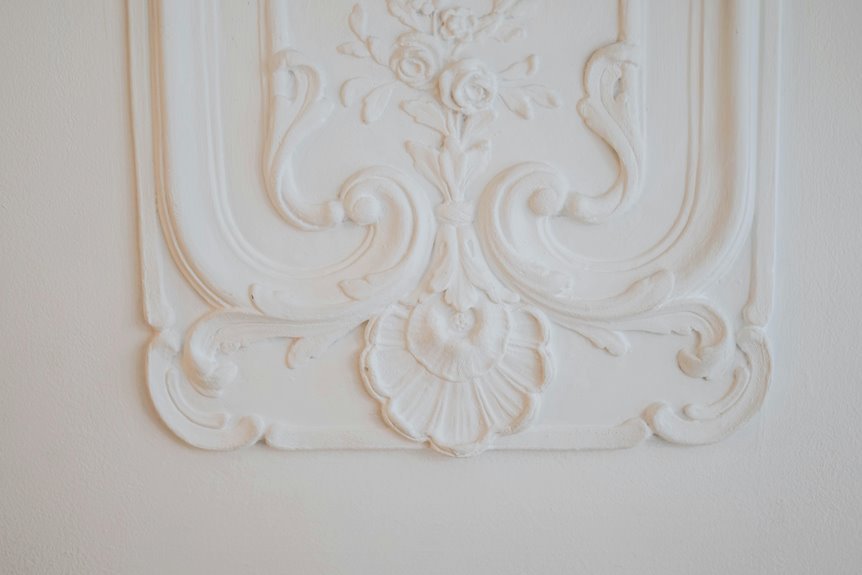
Create beautiful decorative wall moulding by planning your layout carefully, measuring twice, and choosing your molding style.
Sand textured walls, locate studs, and cut pieces precisely with 45-degree miters.
Nail everything into studs, fill gaps with wood filler and caulk, then sand smooth.
Prime and paint your molding and walls with quality finishes, inspect for imperfections, and add crown molding if desired.
Finish with touch-ups for a polished, professional appearance.
Step 1: Plan Your Layout and Measure Your Walls
Before you grab a saw or hammer, you need to complete the planning and measuring phase: measure each wall’s width and height and write down the dimensions. This is where your pattern and layout come together.
Sketch your wall design on paper, aiming for symmetry with an odd number of panels per wall. That middle panel should be wider to anchor the composition. Your measurements determine panel sizes, so accuracy matters.
Account for windows and doors as visual elements. Note ceiling height and crown molding placement for alignment. Create a scale drawing before cutting anything—this prevents costly mistakes. Spending time on this step allows you to build with confidence rather than uncertainty.
Step 2: Pick Your Wall Molding Style and Calculate Materials
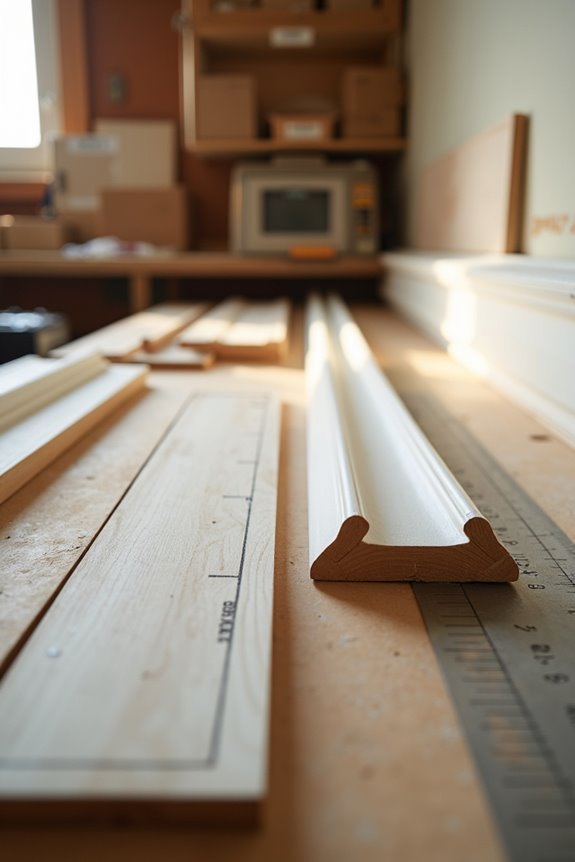
With your measurements locked in, it’s time to choose your molding style. You’ve got three solid options: box molding for clean, structured lines; picture frame molding for that elegant frame-within-a-frame look; or panel molding for traditional charm.
Now calculate your materials. Add up the total perimeter of all your panels, then add 10% for waste—because mistakes happen. Standard moulding lengths come in 8, 10, and 12 feet, so plan your cut list strategically around wall studs and obstacles like windows.
Grab your fasteners, caulk, wood filler, and primer too. This upfront planning prevents mid-project runs to the store and keeps your budget realistic.
Step 3: Sand Textured Walls and Mark Stud Locations
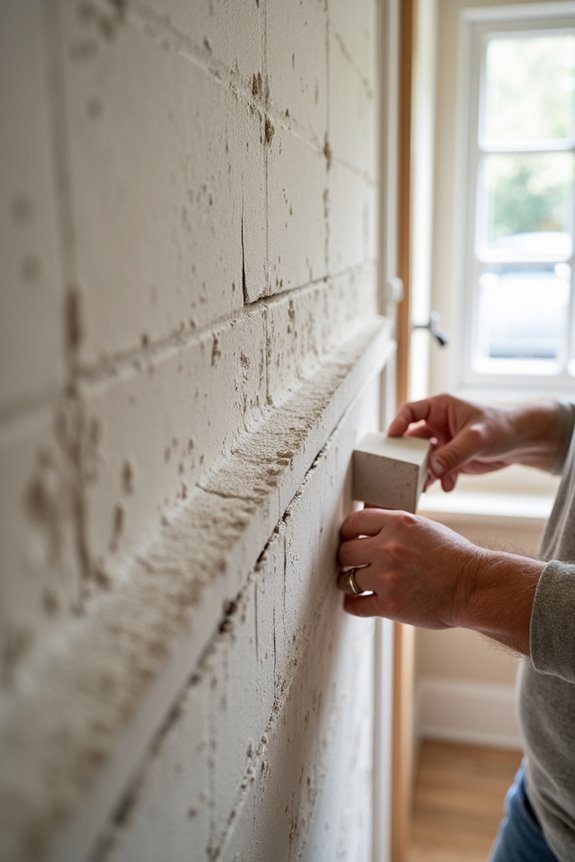
Before you start nailing anything down, sand those textured walls smooth so your moulding adheres properly and looks polished rather than lumpy. Next, grab a stud finder (or a pencil and some patience) to locate and mark where those wooden beams hiding behind your drywall actually are, since nailing into studs keeps everything secure. Once you’ve got your studs marked and your wall prepped, use a level to draw reference lines that’ll keep your moulding straight and true—because crooked trim won’t give you the clean, finished look you want.
Preparing Textured Wall Surfaces
How’s that textured wall looking now—still bumpy and uneven? Time to prepare it as a smooth canvas for your moulding. Start by sanding those textured walls with light passes, smoothing down the high spots that’ll interfere with your moulding installation. You’re not trying to remove everything, just creating better adhesion for primer and paint.
Next, grab your pencil and mark those wall studs—these are your secure nailing points for panels and moulding. If you’ve got stubborn textured areas, patch or skim them to achieve uniformity across sections where moulding will sit.
After sanding, clean thoroughly. Dust particles hiding in texture will sabotage your primer and paint adhesion, so don’t skip this step. A clean wall means better results and fewer frustrating do-overs later.
Locating Wall Studs Accurately
Once you’ve sanded down those bumpy textures and cleaned away all that dust, you’re ready to find the studs hiding behind your walls—this step requires accuracy from the start.
Grab your stud finder and scan methodically across the wall, marking stud centers with pencil. Verify the results by tapping the wall and listening for solid sounds. Create a simple wall map sketching stud locations—this guides your entire panel layout and provides secure attachment.
| Method | Reliability | Best For |
|---|---|---|
| Stud Finder | High | Quick scanning |
| Tapping Test | Medium | Verification |
| Magnetic Finder | High | Double-checking |
For textured walls, probe slightly with a small drill to confirm stud depth. Recording exact locations prevents missed nail placement later.
Marking Reference Lines Precisely
Why do you think professional installers make those straight lines before nailing anything down? They’re actually onto something practical. You’ll want to use a laser level to project reference lines from ceiling to baseboard, maintaining consistent height across your walls. First, measure between inside corners and between walls to establish accurate top and bottom lines. Next, transfer these measurements onto each molding piece at their corresponding wall locations. Here’s where a dry run saves you from headaches—fit your pieces between corners before you commit to nailing. Mark everything clearly so you’re not guessing later. It takes extra work initially, but those crisp, aligned reference lines improve your project’s appearance and accuracy.
Step 4: Cut Your Molding Pieces to Fit Your Design
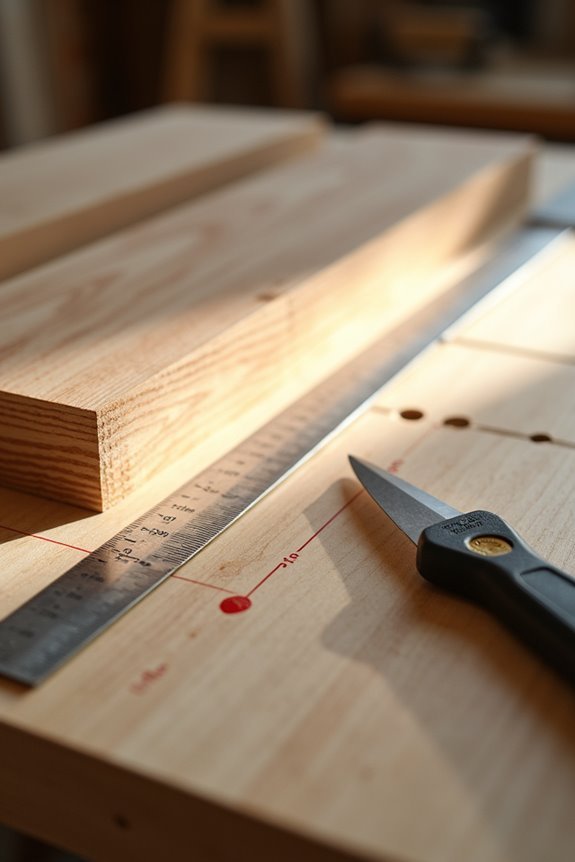
Now comes the fun part where you’ll actually measure and cut—and getting this right makes everything else way easier. You’ll need to measure the distance between your inside corners carefully, mark each piece so you know exactly where it’s going on your wall, and then tackle those tricky 45-degree angled cuts for box corners that’ll make your joints look professional instead of, well, like you just slapped some wood on there. Take your time with these cuts because measuring carefully and cutting once will save you from frustration and wasted trim.
Measuring Between Inside Corners
How’ll you know if your molding pieces actually fit before you nail them to the wall? You’ll measure between inside corners first—it’s the key to avoiding those annoying gaps that’ll frustrate you later.
Here’s what you do: grab your measuring tape and find the exact distance between the two corners you’re working with. Write that number down (seriously, don’t trust your memory). Cut your between-corner piece to that precise length, making sure you add 45-degree miters at both ends for square joints.
Mark each piece with its wall location so you won’t mix them up during installation. Before you attach anything permanently, test-fit that molding piece between your corners. If it slides in smoothly without forcing, you’re good. This simple check prevents frustrating mistakes and keeps your project running smoothly.
Cutting 45-Degree Angled Corners
The miter saw is an essential tool for cutting those perfect 45-degree angles, which is what separates professional-looking molding from amateur work.
Here’s your cutting plan:
| Step | Action |
|---|---|
| Measure twice | Use your inside corner measurements to determine exact lengths |
| Set angle | Adjust miter saw to precisely 45 degrees |
| Cut carefully | Make clean, confident cuts on all outside edges |
Cut a test layout first, marking pieces to their wall locations. This prevents expensive mistakes. After cutting, dry-fit everything on the floor with masking tape before touching your walls. When those mitered corners meet perfectly without gaps, you’ll have achieved a professional result. Small adjustments now save major frustration later.
Step 5: Nail Molding Into Wall Studs
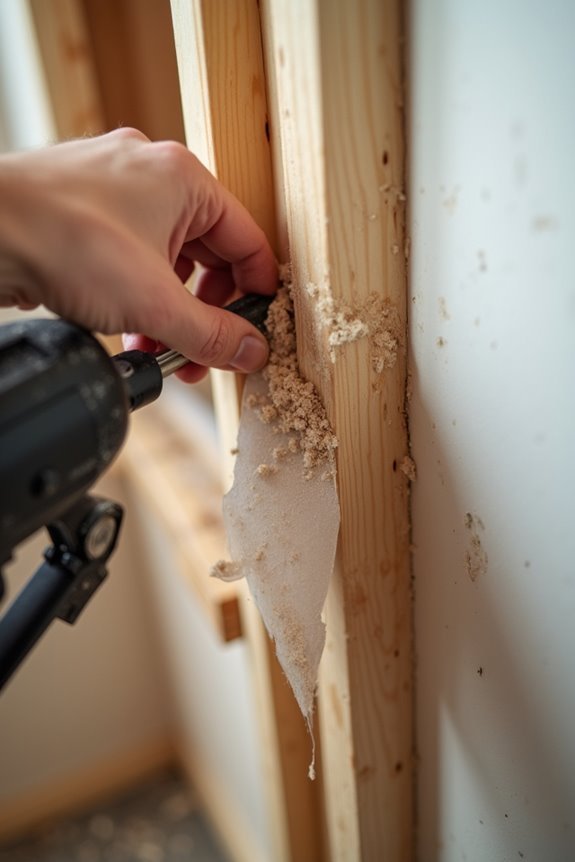
Ever wonder why some DIY projects look professional while others seem to wobble like a newborn giraffe? Nailing your molding correctly makes the difference. You’ll need a finish nail gun and wall studs—not just drywall, which won’t hold anything securely.
First, use a level to align pieces perfectly straight, then mark stud locations on your wall. Drive nails directly into those studs for rock-solid anchorage. Here’s the professional approach: alternate your nail angles slightly to improve grip and prevent pull-out failures.
After fastening everything down, fill those nail holes with wood filler and sand smooth. Then you’re ready for caulking and finishing touches that’ll make your molding look professionally installed.
Step 6: Seal Holes and Gaps for a Smooth Finish
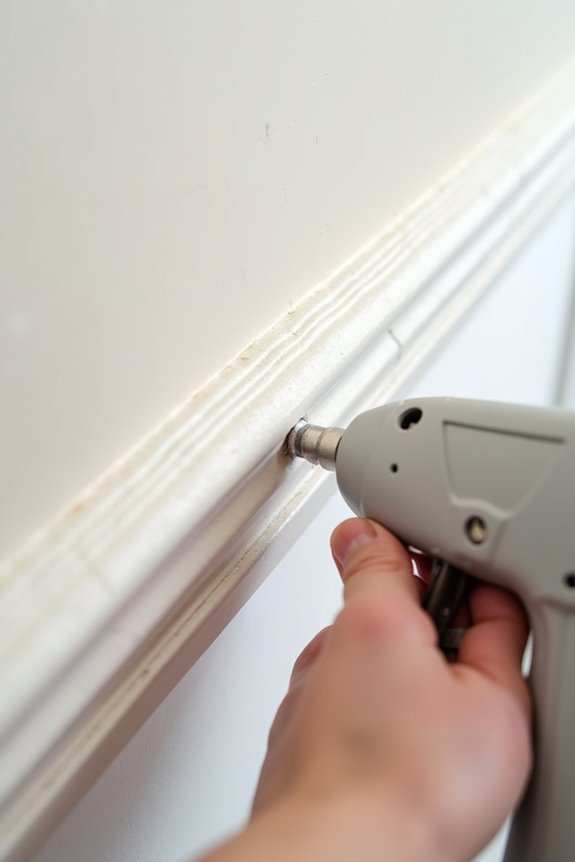
What’s the difference between molding that looks like you installed it yourself versus molding that looks professionally done? The finishing details. You’re almost there, so don’t rush now.
Fill those nail holes and gaps with wood filler, then sand everything smooth. It’s tedious but worth the effort. Next, grab paintable caulk and apply it along the seams where your molding meets the wall—this prevents those annoying visible cracks that scream DIY.
Here’s the professional approach: use a damp cloth to wipe away excess filler or caulk before it dries. You’ll catch imperfections early and avoid extra sanding later. Check those transitions carefully; any remaining gaps need attention now.
This step distinguishes your project from obvious DIY work. Stay focused through the finish line.
Step 7: Prime and Paint Your Molding and Walls
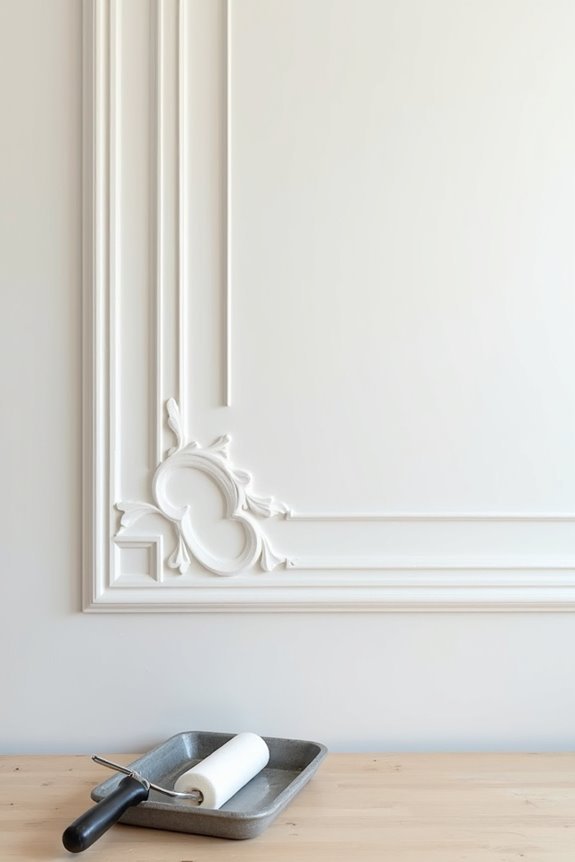
Now that your filler and caulk are completely dry—and I mean really dry, not just “looks dry”—you’re ready for the part that’ll actually make this thing look professional.
First, prime any MDF edges with a quality primer to stop them from soaking up paint like a sponge. Then paint your molding the same color as your walls using a semi or high-gloss finish—this approach saves you from repainting everything. Use an angular brush for those crisp edges you’re after.
Apply two coats of paint on your molding, letting each dry completely between applications. Your walls get a matte finish, creating nice contrast. Sand lightly between coats if needed, then touch up with a smaller roller wherever boxes meet walls.
Step 8: Inspect Installation and Patch Any Paint Gaps
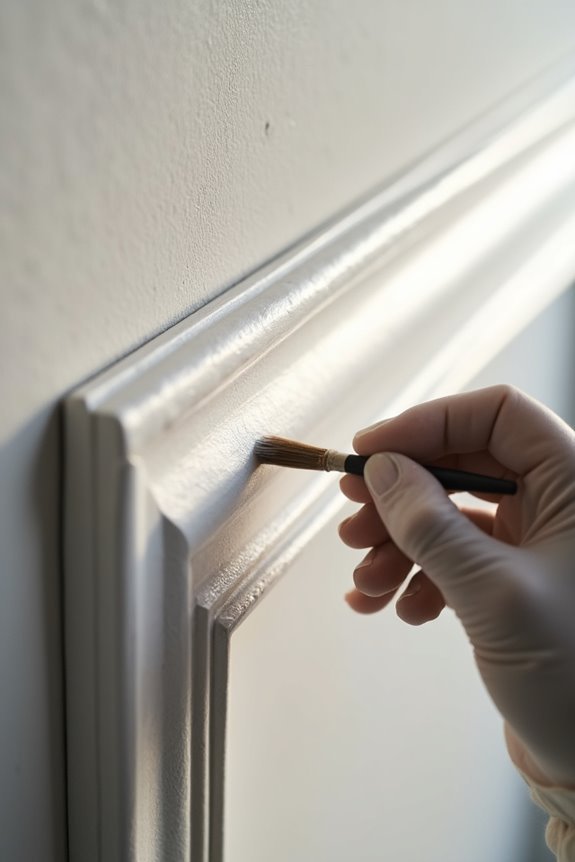
Before you step back and admire your work, you’ll want to do a thorough inspection because those sneaky little gaps have a way of showing up exactly where you don’t want them. Grab your level and check that alignment across the top and bottom edges, making sure spacing stays consistent throughout. Now comes the fun part—patching those gaps. Use wood filler or paintable caulk at corners and where molding meets your walls. Sand everything smooth once it dries, then remove all dust before touching up with matching paint. Apply at least two coats for uniform coverage and a polished paint finish. You’re nearly done with this project.
Step 9: Install Crown Molding to Frame Your Wall Design
Your walls are looking pretty sharp now that those gaps are filled and painted, and you’re probably feeling like a DIY pro—but wait, there’s one more layer that’ll really make your molding setup shine. Crown molding will frame that wall design and tie everything together nicely.
Start by using a laser level to keep proper alignment with your ceiling and existing molding pieces. This keeps your crown lines consistent, especially around windows and doors. Next, decide whether you want crown molding or prefer skipping it—both work great.
Once installed, you’ll handle caulking and filling, then sand smooth. Choose a crown molding finish that matches your wall color and existing molding style. Prime everything, apply final paint coats, and step back to admire your professionally framed work.
Step 10: Final Touches and Touch-Up Paint (Troubleshooting Uneven Walls and Common Gaps)
| Issue | Solution | Tool Needed |
|---|---|---|
| Gaps between moulding and wall | Caulk carefully along seams | Caulk gun |
| Visible nail holes | Fill with wood filler, sand smooth | Putty knife |
| Uneven wall surfaces | Align top line with ceiling using level | Level tool |
| Minor irregularities | Disguise with strategic touch-up paint | Angled brush |
| Roller marks between boxes | Blend transitions with small roller | Paint roller |
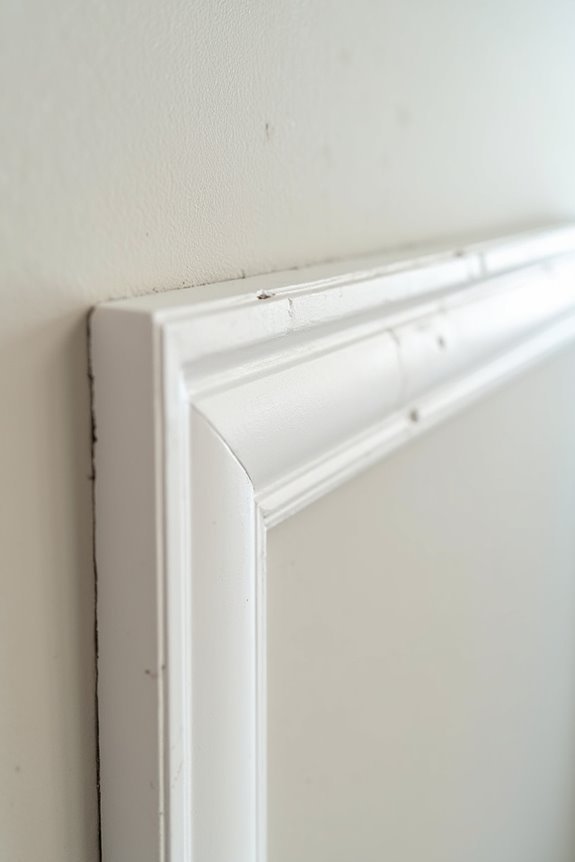
Start by caulking those gaps—they’re sneakier than you’d think. Fill nail holes next, then sand lightly for seamless edges. Check your moulding alignment with a level, adjusting as needed. Finally, apply touch-up paint with an angled brush, blending everything until your walls look intentionally designed rather than accidentally assembled.